In an era when many pickleball facilities are racing to add luxury amenities, sophisticated technology and entertainment options, Pickleball Warehouse in Pittsburgh has taken a different approach. Located inside a century-old industrial building, the facility has focused on something its founder believes matters most: a great place to play pickleball.
Founded by Bryan Wigginton and his wife, Pickleball Warehouse grew from a personal passion for the sport and a desire to create better playing opportunities in western Pennsylvania. It quickly grew into a business venture centered on community, accessibility and the core experience of the game itself.
“My wife and I were looking for something to do together other than sitting on the couch watching TV,” said Wigginton. “We figured it’d be a good fit and it worked. It was something we bonded over.”
While both enjoyed the sport, Wigginton admits he became particularly invested in pickleball. Playing regularly exposed him to a challenge familiar to many players in colder climates: finding quality indoor facilities during winter months and rainy weather.
“I was kind of unhappy with the options here on the winter and the rainy days here in Pittsburgh,” he said. “It was either an old gym or some other facilities that weren’t really meant for pickleball.”
As indoor pickleball facilities began appearing across the country, Wigginton saw an opportunity. The idea seemed straightforward at first. Pittsburgh is known for its industrial history and abundance of warehouse space, making it appear to be an ideal market for a conversion project. The reality proved more complicated.
“I figured Pittsburgh has so many empty warehouses that it’s going to be easy,” said Wigginton. “I’d find one in a couple of weeks. It took me over a year to find the right warehouse.”
The search involved evaluating dozens of properties while balancing several critical factors. Ceiling height, column placement and rental costs all played major roles. While some warehouses were visually appealing, many presented challenges for court layouts or carried costs that would make the business difficult to sustain.
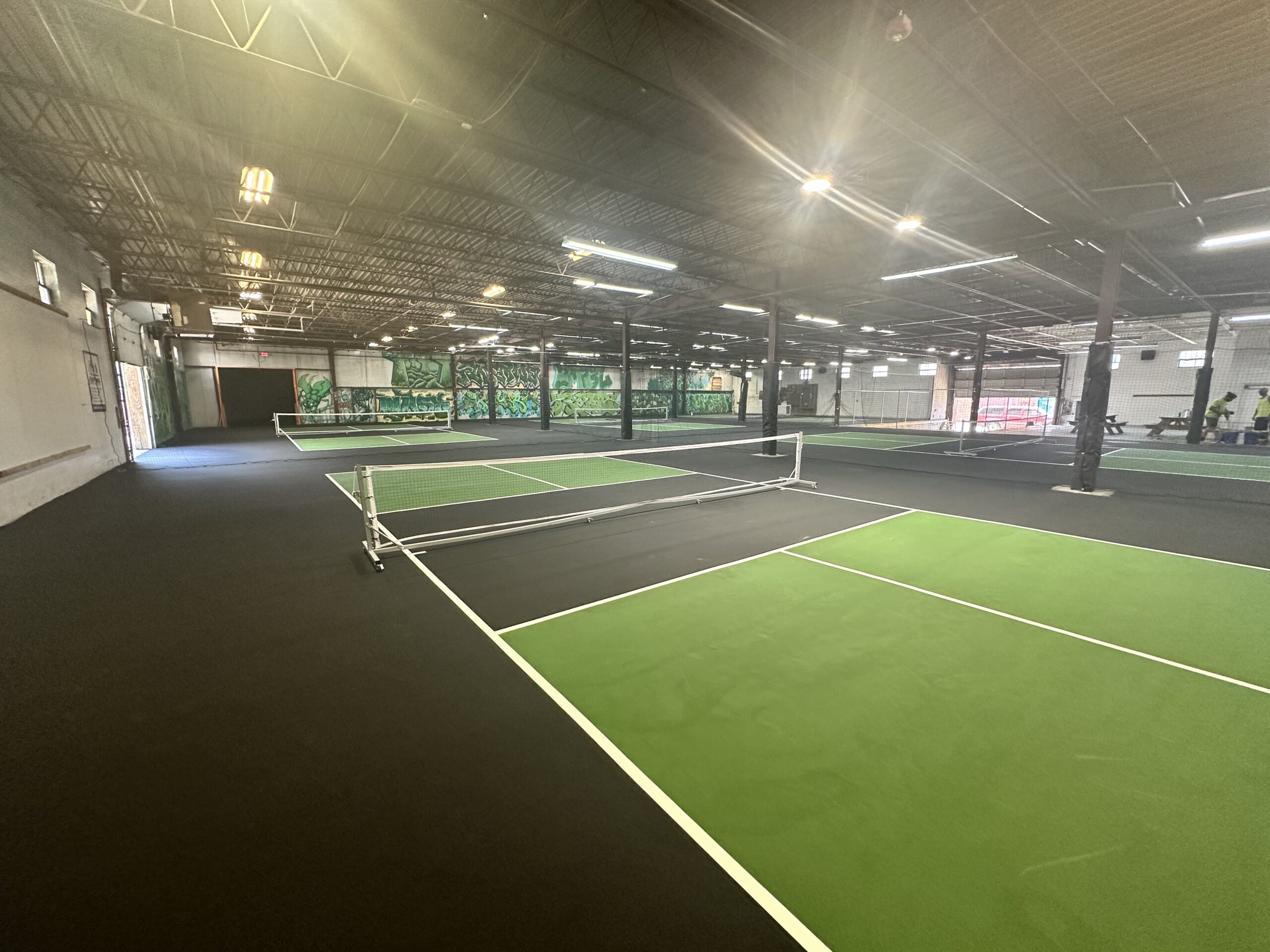
Ultimately, the team found an 80,000-square-foot warehouse that checked the right boxes. The facility offered enough space to support many courts while remaining centrally located within the city.
That decision has helped distinguish Pickleball Warehouse from facilities located farther from population centers, making it easier for players to incorporate pickleball into their daily routines.
The facility’s open play model also separates it from many traditional indoor sports venues, which was driven by Wigginton’s passion for the game.
“What made pickleball so addicting was the pickup nature of it,” said Wigginton. “You can go anytime, find a game, play with some really unique and different people and you could just wind up there for hours.”
He also felt that rigid court reservations often limited the social and spontaneous aspects that attract people to the sport.
“I didn’t like being told when I went to some of these places, ‘You’re done after an hour, you’ve got to get off the court,’” he said.
Instead, Pickleball Warehouse adopted a rotation system inspired by local public park play. The model allows players to drop in, rotate through games and remain engaged for extended periods. The approach has become a key part of the facility’s culture.
Another important component is the club’s skill-level organization. Courts are divided based on playing ability, creating dedicated spaces for beginners, intermediate players and more advanced competitors.
“We feel like the sport is the most fun when you’re playing kind of around your skill level,” said Wigginton. “The rallies are better and the enjoyment is there.”
That structure helps create positive experiences for players across the skill spectrum while providing clear pathways for development.
Building community has become one of the facility’s greatest strengths. While pickleball is often praised for its social nature, Wigginton believes operators must actively create environments that encourage interaction and inclusion.
“We’ve done a nice job of building that community of players,” said Wigginton. “The leveled system seems to be working and the open play model to just drop in and stay for as long as you want seems to be very effective.”
He also recognizes the growing tendency for player groups to become isolated by skill level or social circles and sees the facility’s role as helping break down those barriers.
“You make new friends,” he said. “You play with people you normally wouldn’t.”
The building itself contributes to the experience. Unlike many newer facilities developed from the ground up, Pickleball Warehouse embraces its industrial roots.
“We are literally like a hundred-year-old warehouse that we’ve put pickleball courts in,” said Wigginton. “It has a very unique feel to it that you don’t see a lot.”
Beyond court operations, the facility includes a pro shop that serves as both a convenience for players and a supplemental revenue source. While retail is not the primary business driver, Wigginton has found success through a paddle demo program that allows players to test equipment before purchasing. The concept reflects the same player-first mindset that guides the rest of the operation.
Looking ahead, Wigginton’s vision remains focused on continuous improvement rather than dramatic expansion.
“We’re just trying to make it nicer and bigger every year,” said Wigginton. “Every day we want it to be nicer here than the day before.”
For operators entering the pickleball industry, his advice is simple: prioritize the fundamentals.
“I think pickleball is pretty simple,” said Wigginton. “They just want a nice playing area, a community and to play with people around their skill. If you nail those couple things, the amenities and all those big-ticket items aren’t as important.”
As more facilities compete for players with amenities, Pickleball Warehouse serves as a reminder that the foundation of a successful pickleball business may still be the game itself. By focusing on quality play, meaningful connections and an authentic player experience, the Pittsburgh facility has carved out a distinctive identity in a rapidly evolving industry.

Jordan Meek is a staff writer for Pickleball Innovators, where she covers the rapidly evolving business of pickleball — from facility growth and technology to player experience and industry strategy. A graduate of Denison University with a degree in Journalism, she joined Peake Media in 2025 and brings a passion for storytelling and curiosity to every piece. Jordan is driven to spotlight the leaders shaping the sport and uncover insights that help operators thrive in the fastest-growing game in America. Reach her at jordan@peakemedia.com.