
If 2024 was the year pickleball exploded, 2025 was the year the industry grew up.
At the Pickleball Innovators Summit, one theme came through loud and clear: success is no longer guaranteed by demand alone. Operators are being forced to think more strategically — about real estate, programming, revenue mix, staffing, technology and long-term differentiation.
Here’s a look at the trends that defined 2025 — and what they signal for the road ahead.
1. Pickleball Is Officially a Real Estate Play
In 2025, pickleball fully entered its real estate era.
Operators are no longer asking if pickleball works in their market, but where, how big and under what conditions. Summit discussions repeatedly emphasized drive-time analysis, household income, traffic patterns, lease flexibility and the risk of market shifts between signing a lease and opening day.
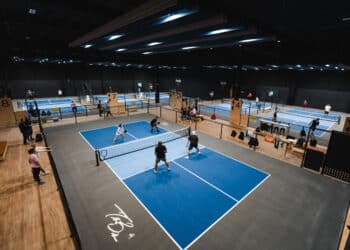
Urban models like Gotham Pickleball Club proved that smaller footprints, smarter tech and programming-first strategies can thrive — while suburban and secondary markets leaned into scale, parking access and family-friendly design.
What’s next: Expect more hybrid models, shared-use spaces and operators treating site selection with the same rigor as health clubs or boutique fitness brands.
2. Courts Are the Product — Not a Line Item
One of the most consistent takeaways from 2025 coverage: court quality is no longer optional.
Operators learned — sometimes the hard way — that surfaces impact safety, retention, word-of-mouth and brand reputation. From premium acrylic systems to cushioned courts and even emerging turf-based solutions, investing in the playing experience became a competitive advantage.
What’s next: As competition increases, surface quality will increasingly define premium versus commodity clubs — and justify pricing differences.
3. Programming, Not Memberships, Drives Revenue
Across Summit roundtables, one truth kept resurfacing: court rentals alone don’t build sustainable businesses.
The strongest operators reported that leagues, clinics, lessons, youth programs, themed events and corporate bookings now account for a significant share — often the majority — of revenue. Programming also solves two major challenges at once: court utilization and community building.
Membership still matters, but it’s being repositioned as an access layer, not the primary value proposition.
What’s next: Expect more structured player pathways — from beginner to competitive — and programming designed around time-of-day utilization, not just skill level.
4. Youth Development Is the Long Game
In 2025, the industry stopped treating youth pickleball as a “nice-to-have” and started viewing it as a strategic necessity.
Operators like The Pickle Lodge shared creative approaches — free play for fifth graders, school partnerships, junior leagues and competitive youth clubs — all rooted in the same insight: today’s juniors are tomorrow’s lifelong members.
Youth programming also brings parents, builds community goodwill and future-proofs the sport.
What’s next: More formal junior pipelines, competitive youth teams and integration with schools, camps and rec systems.
5. Hospitality Thinking Is Separating Winners From Losers
The most successful operators in 2025 didn’t describe themselves as sports facilities — they described themselves as hospitality businesses.
Everything from front-desk energy and cleanliness to seating layouts, food and beverage, and post-play social spaces mattered. Borrowing lessons from fitness and even hotels, operators focused on one key question: Do people want to stay after they play?
If the answer is yes, retention follows.
What’s next: Expect pickleball clubs to continue borrowing from hospitality, wellness and experiential retail — not just sports.
6. Technology Is Now a Requirement, Not a Differentiator
By 2025, frictionless tech moved from “nice bonus” to baseline expectation.
Operators leaned on scheduling software, rating systems, autonomous access, CRM tools and digital marketing to reduce staffing pressure and improve the member experience. The biggest gains weren’t flashy — they were operational: better utilization, clearer data and fewer pain points for players.
What’s next: Data-driven decisions around pricing, programming and staffing will separate scalable operators from lifestyle businesses.
Looking Ahead: From Boom to Business
The takeaway from 2025 is clear: pickleball is still growing — but it’s no longer forgiving.
The next wave of successful operators will be disciplined, data-informed and community-driven. They’ll understand their markets deeply, invest where it matters most and resist the urge to copy-paste models that worked somewhere else.
As we head into 2026, the clubs that thrive won’t just be places to play pickleball — they’ll be places people belong.
And that’s where the real opportunity lies.

With over a decade spent covering the business side of sports and fitness, Rachel Chonko brings a wealth of experience and a true passion for active communities to Peake Media. As Editor-in-Chief, she’s focused on helping pickleball clubs and fitness facilities thrive, from guiding growth strategies to showcasing the latest industry trends. Rachel also hosts the Club Solutions Magazine Podcast, where she interviews leaders in fitness and pickleball to share insights and success stories with the wider community to give her listeners a competitive edge.
After taking up pickleball herself, Rachel has come to appreciate the sport’s unique blend of social connection and active living — a mix that’s perfectly in line with her editorial philosophy. Connect with her on LinkedIn, or check out her articles below for a deep dive into the energy and culture driving pickleball’s rapid rise.