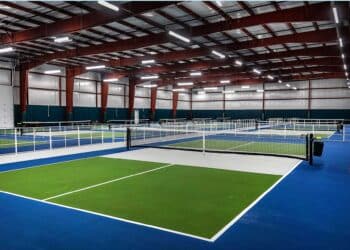
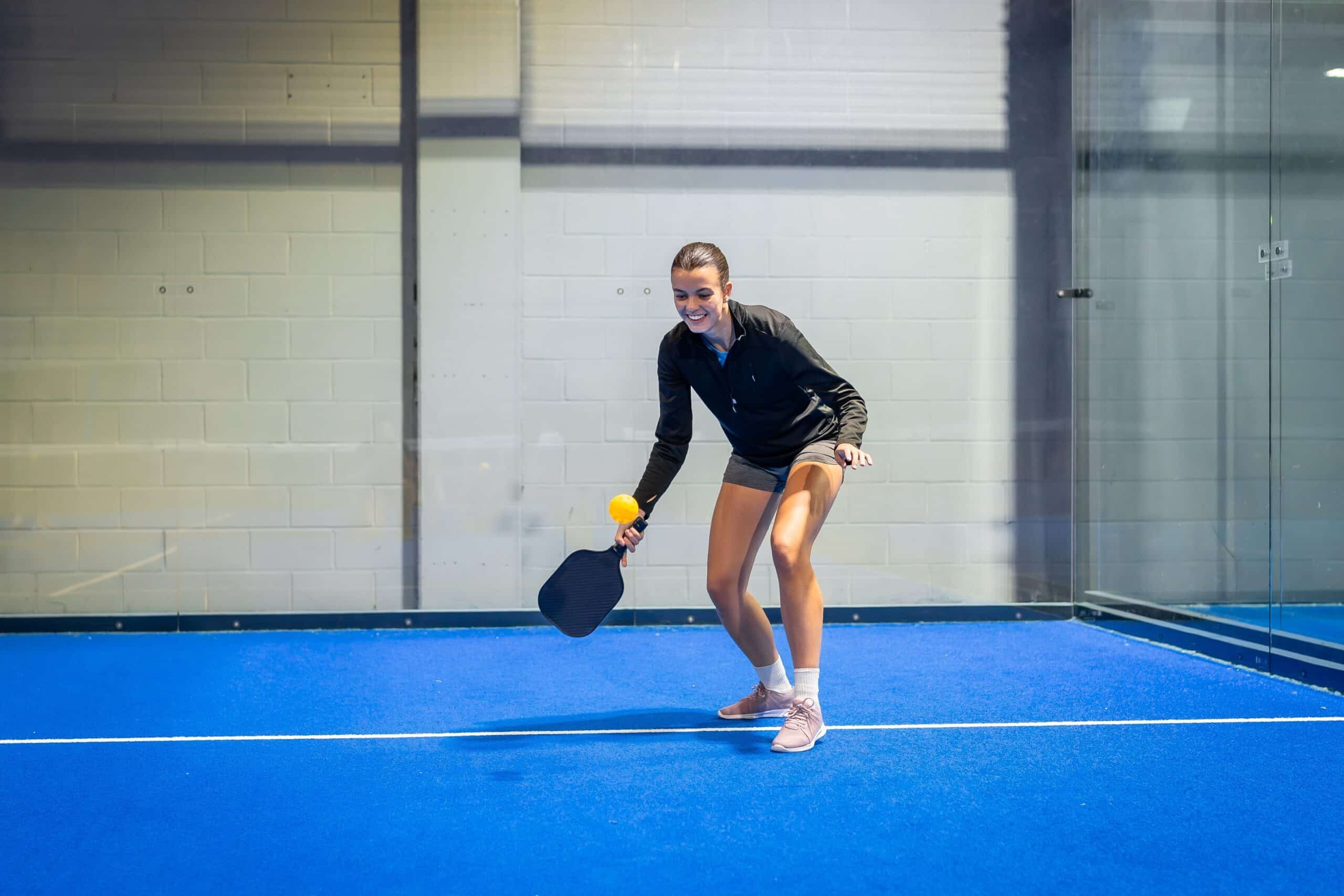
For pickleball facility operators, the early years of the sport’s growth were defined by one question: how do we build enough courts? Now, a more urgent question is taking over — how do we keep them?
Operators are quickly learning that maintenance is no longer just a back-of-house concern. Flooring, lighting and preventative upkeep are tied directly to player retention, operational costs and long-term value. For clubs navigating heavy traffic and constant play, the difference between reactive maintenance and proactive planning can shape both the player experience and the bottom line.
One challenging factor is that pickleball’s wear patterns differ from traditional racquet sports, especially when it comes to court surfaces. The smaller footprint of pickleball courts concentrates traffic into tighter spaces, accelerating deterioration in ways that may not be initially expected.
That has been the case for Christy Howden, the owner of Wolverine Pickleball in Ann Arbor, Michigan.
“When we first built the facility, all court surfacing companies quoted an expected lifespan of seven to 10 years for the indoor surface,” said Howden. “Three years is now what they are saying. The smaller courts and constant use really wear down the texture more quickly than a tennis court.”
Accelerated wear has forced many operators to rethink both budgeting and daily maintenance routines. Instead of viewing resurfacing as a distant expense, clubs are beginning to treat flooring as an ongoing operational investment that requires consistent attention.
At Pickleball X, a Pickleball Kingdom franchisee, director of operations Chirag Patel said their facilities’ approach centers on minimizing the micro-abrasion that gradually breaks down court finishes.
“We perform daily dust removal using a dust broom to remove the ‘micro-grit,’” said Patel. “Even the smallest amounts of dust can act as an abrasive under court shoes.”
That attention to debris management has also changed how operators think about areas outside of the courts themselves. Entryways, parking lots and shoe policies are now also a part of most clubs’ maintenance strategies.
Patel said Pickleball X expanded its entrance mats after discovering a significant portion of court wear stemmed from debris tracked in by players. The brand also enforces a strict court-only shoe policy.
Howden echoed this, emphasizing that keeping courts clean starts well before players step onto the playing surface.
“Heavy-duty entry mats outside the door and entry carpets go a long way to trap dirt,” said Howden. “Having a designated place for players to change their shoes and making that part of the culture helps keep the courts clean.”
Cleanliness has become less about aesthetics and more about extending surface longevity while protecting playability. Howden said Wolverine Pickleball now relies on a combination of walk-behind sweepers and robot vacuums that run overnight to keep dust under control.
“Sweep, sweep, sweep,” emphasized Howden. “The amount of dust collected on a daily basis is mind-boggling.”
Operators are also learning that maintenance protocols must evolve alongside usage patterns. Patel noted that as Pickleball X gathers more data on traffic flow and court usage, the club expects to continually refine its maintenance schedule rather than rely on fixed assumptions established at opening.
While flooring maintenance often gets the most attention, lighting is another critical operational focus. Beyond reducing energy costs, lighting quality directly impacts visibility, player comfort and even how players perceive the professionalism of a facility.
The widespread adoption of LED systems has significantly changed maintenance expectations for clubs. According to Sergio Aguilar, the director of sports lighting at LSI Industries, modern LED sports lighting systems offer longer lifespans, more reliable performance and fewer replacement needs compared to other lighting technologies.
Smart controls also allow operators to remotely monitor fixtures, automate schedules and identify maintenance issues before they become larger operational problems.
At Wolverine, Howden said programmable LED systems have helped reduce staff workload while keeping electricity costs in check.
Patel believes lighting quality should be viewed as one of the most important investments a pickleball operator can make because of its direct influence on gameplay.
“I prioritize lighting above almost any other facility feature because it defines the on-court experience,” said Patel. “You know you’ve invested wisely when the lighting becomes ‘invisible.’ It enables perfect play without ever becoming a distraction or a complaint.”
The concept of “invisible lighting” — systems that players never consciously notice because visibility feels seamless — has become important as competition among facilities grows. Poor glare control, uneven illumination and dark spots can quickly undermine player satisfaction regardless of how attractive the rest of the facility may be.
Improved optics and more uniform light distribution are what lighting providers, like LSI, are saying help reduce complaints that operators may get while lowering maintenance demands at the same time. Purpose-built sports lighting systems are also designed to withstand outdoor exposure and heavy usage more effectively than generic commercial features.
Still, even the best equipment cannot replace consistent preventative maintenance. Patel identified fence upkeep and HVAC servicing as some of the most overlooked and costly maintenance failures in pickleball facilities.
Howden added that maintenance should never fall on a single department or employee. For her team, staff members are assigned upkeep responsibilities during downtime, while a dedicated employee oversees special projects and recurring maintenance schedules throughout the year.
As more facilities move from startup mode into long-term operations, the industry’s take on maintenance is changing. Flooring, lighting and cleaning are all foundational parts of the customer experience. The clubs that treat maintenance as an operational strategy set to protect play quality and the longevity of the business itself are the ones that will be best positioned to succeed.

Jordan Meek is a staff writer for Pickleball Innovators, where she covers the rapidly evolving business of pickleball — from facility growth and technology to player experience and industry strategy. A graduate of Denison University with a degree in Journalism, she joined Peake Media in 2025 and brings a passion for storytelling and curiosity to every piece. Jordan is driven to spotlight the leaders shaping the sport and uncover insights that help operators thrive in the fastest-growing game in America. Reach her at jordan@peakemedia.com.